
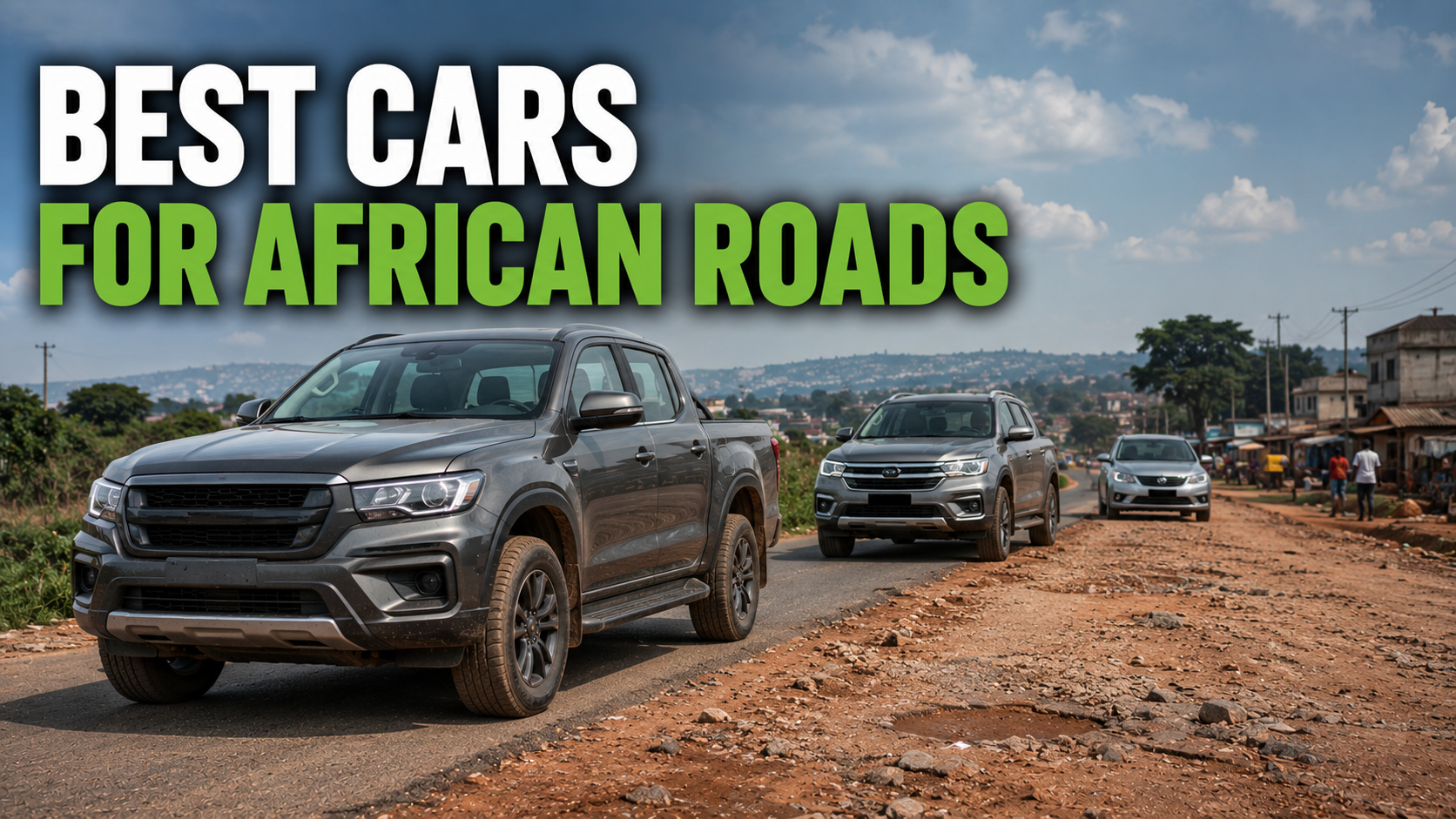

If you’ve ever driven on a badly damaged road, you already know that not every car is built for the experience.
A smooth highway is one thing.
A road filled with potholes, broken surfaces, standing water, loose gravel and deep ruts is something completely different.
This is why choosing the best cars for African roads isn’t simply about finding the newest or most expensive vehicle.
You need something that can handle real-world conditions.
For many African drivers, that means looking for a combination of reliability, ground clearance, strong suspension, fuel economy, affordable maintenance, spare-parts availability and good resale value.
And sometimes, a simple older vehicle can make more sense than a sophisticated new one.
So, what are the best cars for Nigerian roads and other challenging African roads in 2026?
Toyota remains particularly strong, with models such as the Land Cruiser, Hilux, RAV4 and Corolla appearing frequently among vehicles recommended for difficult African conditions. But there are also strong alternatives from Honda, Subaru, Suzuki and other manufacturers.
The important thing is understanding what makes a vehicle suitable for African roads in the first place.
What Makes a Car Good for African Roads?
Before looking at specific models, let’s answer the bigger question.
What should you actually look for?
A good vehicle for African roads should ideally have:
- Good ground clearance
- Durable suspension
- Reliable engine and transmission
- Strong cooling system
- Good fuel economy
- Widely available spare parts
- Mechanics who understand the vehicle
- Strong tires and wheels
- Good resale value
- Suitable 4WD or AWD capability when necessary
These characteristics matter because African driving conditions can be very different from what a vehicle experiences in markets with consistently smooth roads.
A car that performs perfectly on well-maintained highways may struggle when regularly exposed to potholes, rough roads, flooding or unpaved surfaces.
That doesn’t mean you need a massive SUV.
It means you need the right vehicle for your environment.
Best Cars for African Roads in 2026: Quick Answer
If you want the short version, these are some of the vehicles worth considering:
Best overall for extreme conditions: Toyota Land Cruiser
Best pickup truck: Toyota Hilux
Best practical SUV: Toyota RAV4
Best affordable crossover: Toyota Corolla Cross
Best comfortable SUV: Honda CR-V
Best off-road alternative: Subaru Forester
Best budget-friendly small car: Suzuki Swift
Best family SUV: Toyota Fortuner
Best for serious rural work: Nissan Patrol
Best sedan for ordinary roads: Toyota Corolla
But there isn’t one vehicle that wins every category.
Someone driving through central Lagos has very different requirements from someone regularly travelling on rural roads in northern Nigeria.
Likewise, a driver in Nairobi, Accra or Johannesburg may prioritize different things.
1. Toyota Land Cruiser: The Classic African Road Choice
If someone asks you to name a vehicle associated with difficult African roads, there’s a good chance the Toyota Land Cruiser will come up.
And there’s a reason.
The Land Cruiser has developed a reputation for durability in demanding environments, and its combination of four-wheel-drive capability, robust construction and strong parts support has made it popular across many African markets.
A 2026 African-road guide from Faso Cars places the Land Cruiser at the top of its list of SUVs for West African roads, highlighting its ground clearance, 4WD system, reliability and parts availability.
The Land Cruiser is particularly attractive if you regularly travel through:
- Rural areas
- Unpaved roads
- Mud
- Sand
- Rocky terrain
- Poorly maintained roads
- Long-distance routes
However, there’s one obvious problem.
It isn’t cheap.
A Land Cruiser can cost significantly more to purchase and operate than smaller vehicles.
So while it may be one of the most reliable cars in Africa, it isn’t necessarily the best financial choice for someone who spends most of their time driving around a city.
2. Toyota Hilux: Best Pickup for Tough Roads
The Toyota Hilux is another vehicle that has become almost synonymous with tough working conditions.
It’s particularly useful for people who need more than transportation.
If you’re carrying equipment, transporting goods, travelling to farms or working in construction, mining, agriculture or field operations, a pickup can make much more sense than a sedan.
The Hilux combines a rugged chassis with strong load-carrying ability and off-road capability.
Its popularity in African markets also provides another major advantage:
Parts and mechanical knowledge.
AutoTrader South Africa’s 2026 reliability coverage identifies the Hilux as one of the country’s standout dependable vehicles and points to Toyota’s extensive support network as an important ownership advantage.
This matters.
A vehicle isn’t truly practical if you have to wait weeks for a specialized part every time something breaks.
For drivers who need a workhorse rather than a luxury vehicle, the Hilux is difficult to ignore.
3. Toyota RAV4: Best All-Round SUV
Not everyone needs a Land Cruiser.
For many African drivers, the Toyota RAV4 makes more sense.
It’s smaller, easier to drive in cities and generally more practical for everyday family use.
At the same time, it gives you more ground clearance and versatility than a conventional sedan.
The 2026 RAV4 lineup offers between 7.5 and 8.5 inches of ground clearance depending on trim, with the Woodland grade reaching 8.5 inches.
That doesn’t make it an off-road monster.
But it can be useful when you’re dealing with:
- Potholes
- Broken roads
- Gravel roads
- Flood-prone streets
- Uneven surfaces
- Rural trips
The RAV4 is therefore a strong middle ground.
You get SUV practicality without moving all the way up to a large Land Cruiser.
And if fuel consumption matters, Toyota’s hybrid RAV4 options can also make the vehicle attractive for drivers who spend a lot of time on the road.
4. Toyota Corolla Cross: A Smart Choice for City and Rough Roads
The Toyota Corolla Cross is an interesting option for African drivers who want something between a sedan and a traditional SUV.
It has the familiar Corolla name but provides more ground clearance and a higher driving position.
Toyota lists 8.1 inches of ground clearance for the 2026 Corolla Cross.
That extra height can be useful when dealing with potholes, speed bumps and uneven roads.
The Corolla Cross is also easier to live with than a large SUV.
It’s suitable for:
- City driving
- Family use
- Long-distance trips
- Moderate rough roads
- Daily commuting
It isn’t designed to replace a Land Cruiser on serious off-road terrain.
But that’s not really the point.
For someone who spends 80% of their time in the city and occasionally travels on rough roads, the Corolla Cross can be a much more sensible purchase.
5. Honda CR-V: Comfortable and Practical
Toyota isn’t the only manufacturer producing vehicles suitable for difficult roads.
The Honda CR-V is another strong option.
It offers a comfortable interior, useful ground clearance and the practicality of an SUV without being excessively large.
The CR-V can be particularly attractive for families who want a vehicle that works well for both city driving and longer journeys.
Its biggest advantage may be the balance it offers.
You don’t necessarily need a huge 4×4 just because some roads in your area are bad.
Sometimes, a comfortable and reliable crossover with sensible ground clearance is enough.
If you’re deciding between Honda and Toyota, our comparison of Toyota vs Honda reliability looks at reliability, maintenance costs, resale value and long-term ownership.
6. Subaru Forester: A Strong AWD Alternative
The Subaru Forester deserves consideration, especially for drivers who value all-wheel-drive capability.
The 2026 Forester comes with standard Symmetrical All-Wheel Drive, while standard models have 8.7 inches of ground clearance and the Wilderness version increases that to 9.3 inches.
That makes it an interesting option for rough roads, slippery surfaces and challenging weather.
The Wilderness version is particularly focused on off-road capability, with additional underbody protection and increased clearance.
However, there is an important consideration for African buyers.
Parts and servicing.
A vehicle may be excellent mechanically, but if replacement parts are difficult or expensive to find where you live, ownership can become frustrating.
So before choosing a Subaru, check the availability of parts and qualified mechanics in your specific city or country.
7. Suzuki Swift: Small, Simple and Affordable
Not every bad road requires an SUV.
The Suzuki Swift is a good example.
It’s small, relatively lightweight and economical, which can make it attractive for drivers who primarily operate in urban environments.
AutoTrader South Africa’s 2026 reliability coverage lists the Suzuki Swift among its local reliability picks, citing its relatively simple naturally aspirated engine options and lower ownership costs.
The Swift won’t give you the ground clearance or off-road ability of a Land Cruiser.
But if your biggest problems are traffic, fuel prices, narrow streets and occasional potholes, a small reliable car may actually be the smarter choice.
This is an important point:
The best car for African roads isn’t always the biggest car.
8. Toyota Fortuner: A Practical Family SUV
The Toyota Fortuner sits between vehicles like the RAV4 and the larger Land Cruiser in terms of purpose.
It’s a practical option for families who want SUV space while still having the ability to handle more demanding roads.
The Fortuner has also developed a strong reputation in African markets.
Its combination of:
- SUV practicality
- Ground clearance
- Diesel availability in some markets
- Strong resale value
- Toyota parts availability
- Off-road capability
makes it attractive to drivers who regularly leave the city.
For someone who travels between urban and rural areas, it can be a useful compromise.
9. Nissan Patrol: Built for Serious Conditions
If you need something large and powerful, the Nissan Patrol deserves a place on the list.
The Patrol is particularly suited to drivers who need a large SUV capable of handling demanding terrain while carrying passengers and luggage.
It’s also well established in several African and Middle Eastern markets.
However, size comes with disadvantages.
The Patrol can be expensive to purchase, fuel and maintain.
It’s also not the easiest vehicle to maneuver through crowded urban environments.
So unless you genuinely need its size and capability, a smaller SUV may be more practical.
10. Toyota Corolla: The Sedan That Still Makes Sense
Here’s where things get interesting.
You don’t necessarily need an SUV to drive on African roads.
The Toyota Corolla remains one of the most practical sedan choices for many drivers.
Why?
Because reliability and parts availability can be more important than extreme ground clearance when you’re mostly driving on paved roads.
The Corolla is widely recognized across African markets, and mechanics are familiar with it.
Parts are generally easier to find than those for less common models.
It also tends to offer reasonable fuel economy.
So if you’re living in a city where the roads are mostly paved but occasionally rough, don’t feel pressured into buying an SUV simply because of potholes.
A well-maintained Corolla may be all you need.
Why Ground Clearance Matters on African Roads
One of the biggest mistakes buyers make is looking only at engine power.
A powerful engine won’t help much if your vehicle’s underbody constantly hits the road.
Ground clearance matters.
Higher clearance can help a vehicle pass over:
- Potholes
- Rocks
- Road humps
- Deep ruts
- Uneven surfaces
- Flooded sections
For example, Toyota lists the 2026 Corolla Cross at 8.1 inches of ground clearance, while the 2026 RAV4 reaches up to 8.5 inches depending on trim.
The 2026 Subaru Forester reaches 8.7 inches in standard form and 9.3 inches in Wilderness specification.
But don’t assume that the vehicle with the highest number automatically wins.
Suspension design, wheel size, tire sidewall, approach and departure angles and drivetrain capability all matter too.
Why Suspension Durability Matters
African roads can be hard on suspension components.
Constantly hitting potholes can put stress on:
- Shock absorbers
- Control arms
- Bushings
- Ball joints
- Tie rods
- Wheel bearings
- Springs
This is why a vehicle’s ability to absorb rough surfaces is just as important as its ground clearance.
A car can have good clearance and still become expensive to maintain if its suspension isn’t suited to the roads you drive every day.
And remember:
Driving style matters too.
Even a Land Cruiser can suffer if you hit every pothole at high speed.
Slow down when necessary.
Avoid standing water when you cannot judge its depth.
And don’t overload the vehicle.
What About Flooding?
This is particularly important in parts of Nigeria and other African countries where heavy rainfall can create temporary flooding.
A vehicle with higher ground clearance may provide an advantage, but ground clearance does not make a vehicle waterproof.
Water can damage:
- Engine components
- Electrical systems
- Transmission components
- Wheel bearings
- Brakes
- Interior electronics
Even a capable 4×4 has limits.
Never assume that because a vehicle looks rugged, it can safely drive through any flood.
When roads are flooded, the safest option may be to avoid the water altogether.
Are SUVs Always Better for African Roads?
No.
This is one of the biggest misconceptions.
SUVs offer advantages such as higher ground clearance and, in some models, four-wheel-drive capability.
But they also have disadvantages.
They can be:
- More expensive
- Heavier
- Less fuel-efficient
- More expensive to insure
- More expensive to repair
- Harder to park
- More expensive to maintain
If you’re mostly driving around a city, a Corolla, Civic or Swift may be more practical than a giant SUV.
The best choice depends on your actual driving conditions.
Best Cars for Nigerian Roads: What Should You Look For?
Nigeria presents its own combination of challenges.
Depending on where you live, you may encounter:
- Potholes
- Flooding
- Heavy traffic
- Rough urban roads
- Unpaved rural roads
- Long-distance highway driving
- High temperatures
- Dust
- Limited access to specialized service centers
This makes parts availability particularly important.
A vehicle with an excellent international reputation isn’t automatically a good choice if finding its parts locally is difficult.
This is one reason Toyota remains so popular.
The brand’s widespread presence means many Nigerian mechanics are already familiar with common Toyota models.
But popularity should not replace inspection.
A badly maintained Toyota can still become an expensive problem.
What Is the Most Reliable Car Brand in Africa?
There isn’t a single official answer.
Reliability rankings vary depending on the country, data source, model and measurement method.
However, Toyota consistently performs strongly in African automotive markets.
AutoTrader South Africa’s 2026 reliability coverage describes Toyota as the local “gold standard,” particularly highlighting models such as the Hilux and Corolla Cross and the importance of parts availability.
This is important because reliability in Africa isn’t only about how often a vehicle breaks down.
It’s also about:
How quickly can you fix it when something goes wrong?
A vehicle that requires a rare imported component can become a bigger headache than a vehicle that is slightly less sophisticated but has parts available locally.
New vs Used Cars for African Roads
For many buyers, a used vehicle can be the better option.
Why?
Because some older vehicles have already proven themselves in local conditions.
You can see how they perform after several years.
You can ask mechanics about common problems.
You can check parts availability.
And you can often buy them for significantly less than a new vehicle.
But used-car buyers need to be careful.
Check:
- Service history
- Accident history
- Mileage
- Engine condition
- Transmission condition
- Suspension
- Tires
- Cooling system
- Air conditioning
- Electrical components
- Chassis condition
- Signs of flood damage
If you’re buying from the United States, our guide on how to buy a used car in the USA explains the checks you should make before paying.
And if you’re working with a smaller budget, take a look at our guide to the best used cars under $10,000.
What About Fuel Economy?
Fuel economy matters more than many buyers realize.
A large 4×4 may be excellent on rough roads, but if you drive it through heavy city traffic every day, fuel costs can become significant.
That’s why the best vehicle depends on how you use it.
For example:
Mostly city driving: Corolla, Swift, Corolla Cross
Mixed city and rural driving: RAV4, CR-V, Corolla Cross
Frequent rough roads: Fortuner, Hilux, Forester
Serious off-road work: Land Cruiser, Hilux, Patrol
Family transportation: RAV4, CR-V, Fortuner
These aren’t strict rules.
They’re simply a useful starting point.
Does Resale Value Matter in Africa?
Absolutely.
This is another reason Toyota is so attractive to many African buyers.
A vehicle that remains desirable in the used-car market can be easier to sell later.
Strong resale value can reduce your overall cost of ownership because you’re not losing as much money when you eventually replace the vehicle.
This is especially important if you’re importing a vehicle.
Before buying, ask:
“If I need to sell this car three years from now, who will want it?”
A popular model with readily available parts may be easier to sell than an obscure vehicle with limited local support.
How to Choose the Best Car for Bad Roads
Don’t start with the brand.
Start with your road.
Ask yourself:
How often do I drive on unpaved roads?
If the answer is almost never, you probably don’t need a serious off-roader.
How severe are the potholes?
Occasional potholes require a different vehicle from roads where potholes are unavoidable every day.
Do I regularly travel outside the city?
If yes, additional ground clearance and suspension capability become more valuable.
Can I easily find parts?
This should be one of your biggest considerations.
Can local mechanics service it?
A complicated vehicle isn’t very useful if nobody nearby understands it.
Can I afford the fuel and maintenance?
A vehicle that destroys your monthly budget isn’t a good vehicle, regardless of how tough it is.
The Best Car for African Roads May Not Be the Most Expensive
This is worth emphasizing.
You don’t need to spend $50,000 to get a reliable vehicle for African roads.
A properly maintained Toyota Corolla can be a better purchase for one person than a brand-new Land Cruiser.
A Suzuki Swift may be better for a city commuter.
A RAV4 may be ideal for a family.
A Hilux may be perfect for someone working in agriculture or construction.
A Land Cruiser may be justified for someone who regularly travels through extremely rough terrain.
The best vehicle is the one that matches your road, your budget and your lifestyle.
Conclusion
So, what are the best cars for African roads in 2026?
There isn’t one universal winner.
For extreme conditions, the Toyota Land Cruiser remains one of the strongest choices.
For work and rough roads, the Toyota Hilux is difficult to overlook.
For everyday SUV use, the Toyota RAV4 offers a strong balance between practicality and capability.
The Toyota Corolla Cross is another smart option for drivers who want extra ground clearance without moving into a large SUV.
The Honda CR-V provides a comfortable alternative, while the Subaru Forester offers standard all-wheel drive and strong ground clearance.
For budget-conscious city drivers, the Suzuki Swift and Toyota Corolla can make more sense than a large 4×4.
And that’s really the biggest lesson.
Don’t buy a vehicle simply because someone tells you it’s the most reliable car in Africa.
Look at your roads.
Look at your budget.
Look at fuel consumption.
Look at parts availability.
Look at the maintenance history.
And think about where you’ll actually drive.
Because when it comes to African roads, reliability isn’t just about surviving a pothole. It’s about being able to keep the car running, maintain it affordably and find the parts you need when something eventually goes wrong.
That’s what makes a vehicle truly reliable.