
Buying a used car can be one of the smartest ways to get reliable transportation without paying the price of a brand-new vehicle.
But there’s a problem.
A used car can look perfect in an online listing and still have expensive mechanical problems, accident damage, title issues or a history the seller doesn’t want to discuss.
That’s why knowing how to buy a used car is about more than finding a good-looking vehicle at a low price.
You need to know what you’re buying.
You need to know what you’ve paid.
And most importantly, you need to know what you’re agreeing to before you hand over your money.
The good news is that you don’t need to be a professional mechanic to make a smarter used-car purchase.
You just need to check the right things.
If you’re wondering how to buy a used car in the USA, this guide walks you through the 10 most important things to check before you pay.
How to Buy a Used Car in the USA: The Quick Answer
Before buying a used car, check:
- The vehicle’s price and your total budget
- The VIN and vehicle history
- The title status
- The mileage
- The exterior and signs of accident damage
- The interior and electronics
- The engine, transmission and fluids
- The tires, brakes and suspension
- The results of an independent inspection and test drive
- The paperwork, warranty and final purchase price
And there’s one rule worth remembering:
Never let a seller’s urgency replace your inspection.
If someone tells you that you have to pay immediately because another buyer is waiting, take a step back.
A good car can be inspected.
A good deal should survive a few questions.
1. Check Your Budget Before You Start Shopping
The first mistake many used-car buyers make is starting with the car.
You should start with your budget.
If you have $15,000 available, that doesn’t necessarily mean you should spend the entire $15,000 on the vehicle.
You may also need money for:
- Sales tax
- Registration
- Title fees
- Insurance
- Maintenance
- Tires
- Repairs
- Financing costs
- Dealer fees
- Other optional products or services
This matters because a $13,000 used car can become considerably more expensive once all the additional costs are included.
If you’re financing, look beyond the monthly payment.
A dealer may make a vehicle appear affordable by extending the loan term.
Instead of asking:
“Can I afford this monthly payment?”
ask:
“How much will this car cost me in total?”
That’s a much better question.
How Much Should You Spend on a Used Car?
There isn’t one perfect budget for everyone.
A college student, a first-time buyer and a family replacing an old vehicle will all have different financial situations.
The important thing is to leave room for ownership costs.
For example, if you’re buying a $10,000 used car, don’t assume your entire budget should go toward the purchase price.
You may want to keep some money available for unexpected repairs.
This is especially important with older vehicles.
A cheap car isn’t necessarily a cheap car to own.
A $7,000 vehicle that immediately needs a $3,000 transmission repair isn’t the bargain it appeared to be.
If your budget is under $10,000, our guide to the best used cars under $10,000 can help you identify models worth considering.
2. Check the VIN and Vehicle History
This is one of the most important steps when buying a used car.
Every vehicle sold in the United States has a Vehicle Identification Number, commonly called a VIN.
The VIN is a unique 17-character identifier that allows you to research the vehicle’s history.
Before buying, get the VIN and use it to investigate the car.
The Federal Trade Commission recommends getting a vehicle history report before purchasing a used vehicle. A report can reveal information such as ownership history, reported accidents, repair records and whether the vehicle was declared salvage.
A vehicle history report may reveal:
- Previous owners
- Reported accidents
- Title problems
- Salvage history
- Insurance losses
- Some repair records
- Mileage information
- Other historical events
But don’t make the mistake of thinking a clean history report means the car is automatically perfect.
It doesn’t.
The FTC specifically notes that a vehicle history report is not a substitute for an independent inspection because reports may not contain mechanical problems.
Think of the history report as one piece of the puzzle.
Not the entire puzzle.
Check the VIN Yourself
Don’t simply accept a VIN written down by the seller.
Compare the VIN on the listing and paperwork with the VIN physically displayed on the vehicle.
Look for the VIN on the driver’s side dashboard and other locations on the vehicle.
You want the numbers to match.
If the VIN on the car doesn’t match the paperwork, stop the transaction until you understand why.
A mismatched VIN can be a major warning sign.
The National Insurance Crime Bureau also warns consumers about vehicle cloning, where criminals copy a legitimate VIN and use it on a stolen vehicle.
For additional protection, you can use the NICB’s free VINCheck service to see whether a vehicle has been reported as stolen and unrecovered or declared salvage by participating insurers.
3. Check the Title Status
The title is one of the most important documents in a used-car transaction.
Don’t just ask:
“Does it have a clean title?”
Look at the actual documentation.
You want to understand whether the vehicle has:
- A clean title
- Salvage title
- Rebuilt title
- Flood damage history
- Other title brands
- An outstanding lien
Title terminology can vary by state, so don’t assume every vehicle described as “clean” has the same history.
A vehicle that has previously been declared a total loss may have significant hidden damage even if it has since been repaired.
This is one reason a low price can sometimes be misleading.
The car may be cheap because its history makes it harder to insure, finance or resell.
What Is a Salvage Title?
A salvage title generally indicates that a vehicle was declared a total loss under applicable state rules or insurance circumstances.
That doesn’t automatically mean the vehicle is undriveable.
But it does mean you need to understand why it received that title.
Was it involved in a major collision?
Was it damaged by flooding?
Was it stolen and later recovered?
Was it rebuilt?
Ask questions.
And get documentation.
The NICB warns that flood-damaged and salvage vehicles can sometimes be hidden through title washing, where a vehicle is moved between states to obtain documentation that conceals its previous damage.
If the title history doesn’t make sense, walk away.
4. Check the Mileage
Mileage matters.
But don’t treat the odometer number as proof that the vehicle is in good condition.
A 10-year-old car with 80,000 miles might be a great purchase.
A five-year-old car with 50,000 miles might be a terrible one.
It depends on how the vehicle was driven and maintained.
When checking mileage, compare the odometer with:
- Vehicle history reports
- Maintenance records
- Inspection records
- Registration documents
- Service receipts
- Previous listings, where available
You’re looking for consistency.
If the vehicle history shows 120,000 miles several years ago but the dashboard currently shows 85,000, that’s a major warning sign.
Don’t assume the discrepancy is harmless.
Ask for an explanation and documentation.
Is High Mileage Always Bad?
Not necessarily.
A well-maintained Toyota Corolla with 120,000 miles can potentially be a better purchase than a neglected vehicle with 70,000 miles.
Maintenance history matters.
Driving conditions matter.
Previous ownership matters.
Highway miles can also be very different from years of short trips and stop-and-go city driving.
Instead of asking:
“How many miles does it have?”
ask:
“How was this car maintained?”
That’s a much more useful question.
5. Check the Exterior for Accident Damage
Now it’s time to inspect the physical vehicle.
Don’t rush this part.
Look at the car in good daylight if possible.
Walk around the entire vehicle.
Check for:
- Different paint shades
- Uneven panel gaps
- Scratches
- Dents
- Rust
- Cracked lights
- Damaged bumpers
- Windshield damage
- Signs of previous bodywork
- Overspray around panels
- Mismatched exterior parts
A difference in paint color doesn’t automatically mean the car was badly damaged.
It could have been repaired after a minor accident.
But it gives you a reason to ask questions.
Open the hood and look at the areas around the engine bay.
Check for signs that panels or structural components have been replaced or repaired.
You don’t need to diagnose collision damage yourself.
You’re looking for clues.
Look Under the Car
If it’s safe to do so, inspect underneath the vehicle.
Look for:
- Fresh oil leaks
- Coolant leaks
- Excessive rust
- Damaged components
- Signs of previous repairs
- Fluid around the transmission
- Damaged exhaust components
A small amount of dirt underneath an older vehicle isn’t unusual.
Fresh fluid dripping from the vehicle is different.
If you see something concerning, ask the seller what it is.
Better yet, have a mechanic inspect it.
6. Check the Interior and Electronics
The inside of the vehicle can tell you a surprising amount about how it was treated.
Look at:
- Seats
- Carpets
- Dashboard
- Steering wheel
- Door panels
- Seat belts
- Windows
- Air conditioning
- Heating
- Infotainment system
- Backup camera
- Speakers
- Power seats
- Power locks
- Interior lights
Turn everything on.
Don’t assume the seller has tested it.
Check whether the air conditioning actually gets cold.
Test the windows.
Test the locks.
Try the headlights.
Check the turn signals.
Test the windshield wipers.
Try the infotainment system.
If the car has a backup camera, make sure it works.
Small electrical problems can become annoying and expensive after purchase.
Look for Signs of Water Damage
Flood damage deserves special attention.
A vehicle can sometimes be cleaned up and made to look presentable after water exposure.
Look for warning signs such as:
- Musty smells
- Water stains
- Damp carpets
- Rust in unusual places
- Mud or sand under carpets
- Moisture inside lights
- Corrosion around electrical connections
- Recently replaced carpets
- Moisture inside seat-belt retractors
The NICB specifically lists water stains, mildew, sand, unusual rust and mud in areas such as around the spare tire as potential warning signs of flood damage.
If something feels suspicious, don’t ignore it because the car looks clean.
7. Check the Engine, Transmission and Fluids
You don’t have to be a mechanic to perform a basic inspection.
Start by asking the seller whether you can see the vehicle when the engine is cold.
A cold start can reveal problems that may be less obvious once the engine has warmed up.
When starting the vehicle, listen for:
- Excessive knocking
- Loud ticking
- Grinding
- Unusual rattling
- Excessive vibration
- Difficulty starting
Watch the exhaust.
Persistent unusual smoke can be a warning sign.
Then check the fluids.
Depending on the vehicle, these may include:
- Engine oil
- Coolant
- Brake fluid
- Transmission fluid
- Power steering fluid
The exact procedure varies by vehicle, so don’t open or inspect anything you’re not comfortable handling.
You’re not trying to diagnose the engine in a parking lot.
You’re looking for obvious warning signs.
What About the Transmission?
During the test drive, pay close attention to how the transmission behaves.
Watch for:
- Delayed engagement
- Harsh shifting
- Slipping
- Grinding
- Unusual noises
- Shaking during shifts
A transmission problem can be extremely expensive.
If the vehicle doesn’t shift normally, don’t assume it just needs “a little adjustment.”
Get it inspected.
8. Check the Tires, Brakes and Suspension
Tires are easy to overlook because buyers tend to focus on the engine and body.
But tires can be expensive.
Check:
- Tire tread
- Uneven wear
- Cracks
- Tire age
- Matching tire sizes
- Spare tire condition
Uneven tire wear can sometimes point toward alignment, suspension or other mechanical problems.
Then test the brakes.
During the test drive, pay attention to:
- Vibrations
- Pulling to one side
- Grinding
- Squealing
- A soft brake pedal
- Excessive pedal travel
Also pay attention to how the vehicle behaves over bumps.
Unusual clunks or excessive bouncing may indicate suspension problems.
You don’t need to identify the exact failed component.
You just need to recognize when something doesn’t feel right.
9. Get an Independent Inspection and Take a Proper Test Drive
This may be the most important step on the entire list.
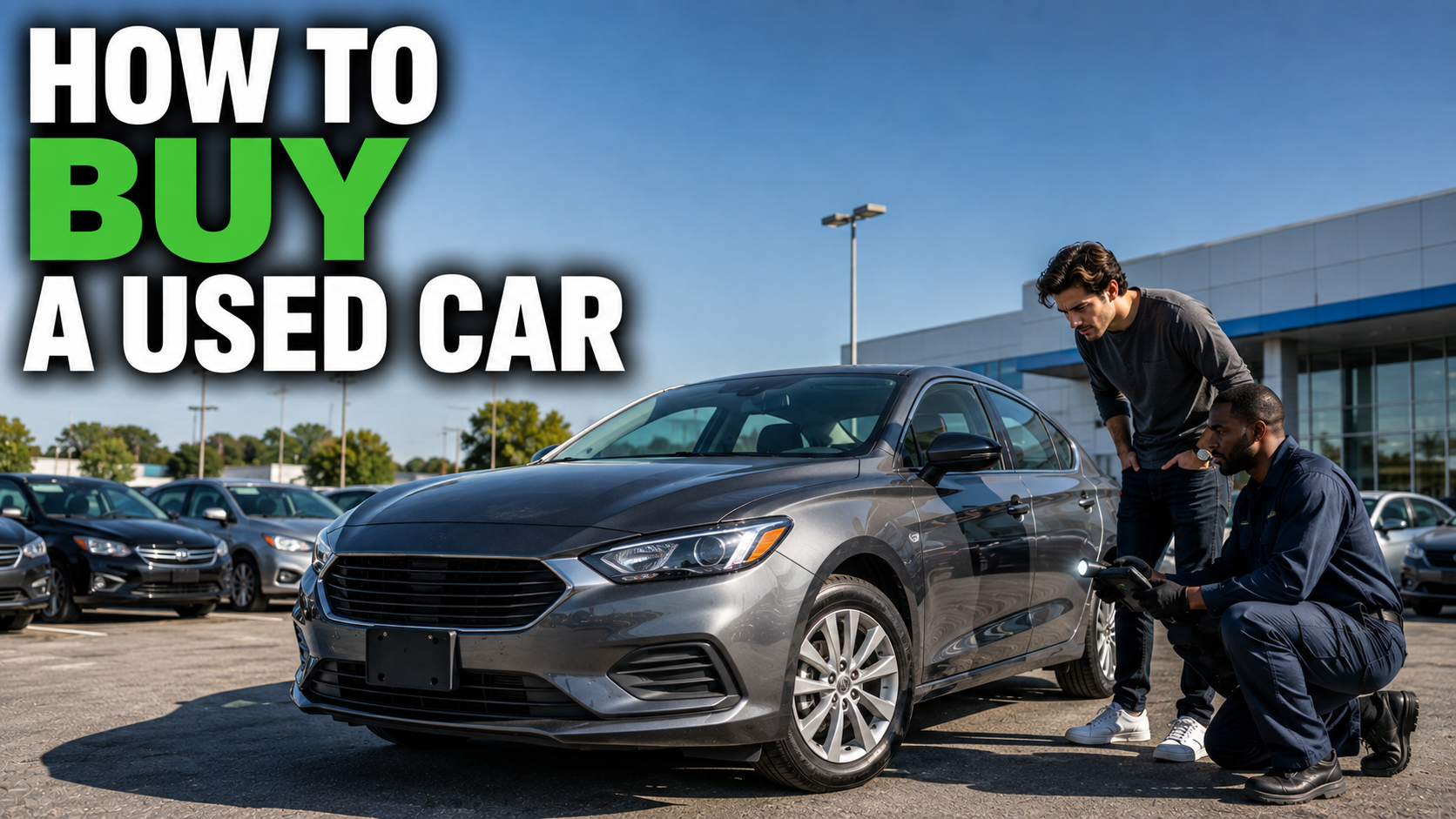
Get an independent mechanic to inspect the car before you buy it.
Not your friend’s mechanic who happens to work for the dealership.
Not only the dealer’s inspection.
An independent mechanic.
The FTC recommends an independent inspection because a vehicle history report does not replace a mechanical inspection. The FTC also says that if a dealer refuses to allow an independent inspection, you should consider taking your business elsewhere.
The inspection can identify problems you may not notice yourself.
Ask the mechanic for a written report.
Ideally, the report should identify the vehicle’s make, model and VIN and provide information about necessary repairs.
The inspection costs money.
But spending money before buying a car can save you much more money after buying one.
What Should You Do During the Test Drive?
Don’t drive around the block for 90 seconds and call it a test drive.
If possible, experience different driving conditions.
Pay attention to:
Starting
Does the engine start easily?
Acceleration
Does the car accelerate smoothly?
Braking
Does it stop straight without strange noises or vibrations?
Steering
Does the vehicle pull to one side?
Transmission
Are shifts smooth?
Suspension
Does the vehicle make unusual noises over bumps?
Highway driving
Does the car feel stable at higher speeds?
Temperature
Does the engine remain at a normal operating temperature?
Turn off the radio during part of the test drive.
You want to hear the car.
10. Check the Paperwork, Warranty and Final Price
You’ve inspected the vehicle.
You’ve checked the history.
You’ve driven it.
Now check the paperwork.
This is where you need to slow down.
If you’re buying from a dealer, the Federal Trade Commission requires dealers to display a Buyers Guide on used vehicles they offer for sale, with important information about warranty coverage and whether the vehicle is being sold “as is.”
Read it.
Don’t just sign it.
What Does “As Is” Mean?
If a vehicle is sold “as is,” the dealer generally isn’t promising to cover future repairs under a warranty.
That makes your inspection even more important.
If the seller promises to fix something, don’t rely on a verbal promise.
Get it in writing.
The FTC specifically advises consumers to get promises in writing because spoken promises can be difficult to enforce.
Ask:
- Is there a warranty?
- What exactly does it cover?
- How long does it last?
- Who pays for covered repairs?
- Is the vehicle being sold as-is?
- Are there dealer fees?
- Are there optional add-ons?
- What is the final out-the-door price?
Don’t focus only on the advertised price.
Ask for the total price you’ll actually pay.
Watch Out for Dealer Add-Ons
Some dealerships offer optional products and services during the purchase process.
These can include things such as:
- Gap insurance
- VIN etching
- Protection products
- Service contracts
- Rustproofing
- Other aftermarket products
The FTC warns that dealer add-ons can sometimes cost thousands of dollars and may be presented late in the buying process.
If you don’t want an add-on, say so.
And make sure you understand exactly what you’re paying for before signing.
Don’t Forget to Check for Open Recalls
Before you pay, check whether the vehicle has any open safety recalls.
You can use the National Highway Traffic Safety Administration’s recall lookup tool and enter the vehicle’s VIN.
NHTSA says consumers can check for open recalls using the VIN, and recall repairs are generally performed for free by the manufacturer’s dealership.
A recall isn’t necessarily a reason to reject a vehicle.
But you should know about it.
If there is an unrepaired safety recall, ask the seller about it and determine whether the repair has been completed before you finalize the purchase.
Used Car Buying Checklist
Before paying for a used car, run through this list:
- Confirm the vehicle fits your budget
- Get the VIN
- Compare the VIN on the vehicle with the paperwork
- Run a vehicle history report
- Check the title status
- Check for salvage or flood history
- Verify the mileage
- Inspect the exterior
- Look for accident-repair signs
- Check underneath the vehicle
- Inspect the interior
- Test the electronics
- Check for water-damage signs
- Inspect the engine
- Test the transmission
- Check tires and brakes
- Take a proper test drive
- Get an independent mechanic inspection
- Check for open recalls
- Read the Buyers Guide if purchasing from a dealer
- Confirm warranty coverage
- Ask about dealer add-ons
- Get all promises in writing
- Confirm the final out-the-door price
- Review all paperwork before signing
If the seller refuses several of these basic requests, that’s information too.
You don’t have to buy that car.
Private Seller vs. Dealership: Which Is Better?
There are advantages and disadvantages to both.
A dealership may offer:
- More vehicles to choose from
- Financing options
- Warranty options
- Trade-in opportunities
- More standardized paperwork
But the price may be higher and you may encounter dealer fees or optional add-ons.
A private seller may offer:
- Lower prices
- Direct communication with the owner
- More room for negotiation
- Detailed information about how the vehicle was used
But you may have fewer protections and need to handle more of the research yourself.
Regardless of where you buy, the basic rule remains the same:
Inspect the vehicle before you pay.
What Should You Never Do When Buying a Used Car?
There are a few mistakes worth avoiding.
Don’t buy without seeing the car.
Photos aren’t enough.
Don’t skip the vehicle history report.
You need to know what you’re buying.
Don’t skip the independent inspection.
A clean-looking car can still have mechanical problems.
Don’t trust verbal promises.
If something matters, put it in writing.
Don’t let a seller pressure you.
A legitimate deal shouldn’t require you to ignore obvious warning signs.
Don’t focus only on the monthly payment.
Look at the total cost.
Don’t assume low mileage means good condition.
Maintenance history matters.
Don’t ignore the title.
A cheap car with serious title problems can become an expensive mistake.
How to Negotiate the Price of a Used Car
Once you’ve completed your inspection, you’ll have more information to negotiate.
Don’t simply say:
“Can you do $12,000?”
Instead, use the condition of the vehicle.
For example:
The mechanic found that the tires need replacement.
The brakes will need attention soon.
The vehicle has cosmetic damage.
The service history shows upcoming maintenance.
These are legitimate reasons to discuss the price.
But remember:
Negotiating isn’t about trying to get the lowest possible price.
It’s about paying a fair price for the actual condition of the vehicle.
A seller who refuses a reasonable negotiation isn’t automatically selling a bad car.
And a seller who accepts a huge discount isn’t automatically giving you a great deal.
The inspection and history matter more than the size of the discount.
Should You Buy a Used Car With an Accident History?
Not necessarily.
An accident on a vehicle history report doesn’t automatically mean the car is unsafe or a bad purchase.
The important questions are:
- How serious was the accident?
- Which parts were damaged?
- Was the frame affected?
- Who repaired the vehicle?
- Are there repair records?
- Was the vehicle properly inspected?
- Does the car drive normally?
- What does an independent mechanic think?
A minor accident with professional repairs is very different from a vehicle that suffered major structural damage.
Don’t automatically reject every car with an accident history.
But don’t ignore serious damage either.
What About Buying a Used Car Online?
Buying a used car online can be convenient.
You can compare dozens of vehicles without visiting multiple dealerships.
But convenience can also make buyers careless.
Before sending money, make sure you:
- Verify the seller
- Verify the VIN
- Review the vehicle history
- Confirm the title
- Arrange an independent inspection
- Understand the payment process
- Understand delivery arrangements
- Confirm the return policy, if one exists
- Get all agreements in writing
Be particularly careful if someone wants you to send money before you’ve independently verified the vehicle.
A low price is not worth losing your money.
What If You’re Buying a Used Car to Export to Nigeria?
This is particularly important for buyers who aren’t planning to keep the vehicle in the United States.
If you’re buying a used car in the USA because you eventually want to ship it to Nigeria, you should think beyond the purchase price.
You’ll need to consider:
- Vehicle condition
- VIN and title history
- Shipping costs
- Port charges
- Customs requirements
- Import duties and taxes
- Clearing costs
- Vehicle age and eligibility requirements
- Transportation after arrival
A car that looks cheap in the United States may not remain cheap after shipping and import costs are added.
Before buying, calculate the landed cost rather than just the American purchase price.
Our guide on how to ship a car from the USA to Nigeria explains the major steps involved in the shipping and import process.
And if you’re specifically comparing the financial side of importing a vehicle, our guide to Nigeria car import duty can help you understand the costs you need to account for.
How to Know When You Should Walk Away
Sometimes the smartest thing you can do is leave.
Walk away if:
- The VIN doesn’t match
- The seller refuses to provide basic documentation
- The title situation is unclear
- The seller won’t allow an inspection
- The vehicle has unexplained major damage
- The history contains serious inconsistencies
- The seller pressures you to pay immediately
- The price seems suspiciously low
- The seller refuses to put important promises in writing
- The car has mechanical problems you’re not prepared to repair
There will always be another used car.
That’s one of the biggest advantages of shopping in the United States.
You don’t have to make a bad purchase simply because you’ve already spent two hours looking at a vehicle.
How to Buy a Used Car: The 10-Step Formula
If you want to make the process as simple as possible, remember this:
1. Set your budget.
Know what you can comfortably spend.
2. Research the vehicle.
Understand the model’s common problems, reliability and ownership costs.
3. Get the VIN.
Don’t move forward without it.
4. Check the vehicle history.
Look for accidents, title problems, mileage issues and other warning signs.
5. Check the title.
Make sure you understand exactly what you’re buying.
6. Inspect the vehicle.
Look at the body, interior, engine, tires and underneath the car.
7. Take a test drive.
Listen and feel for problems.
8. Get an independent inspection.
Let a qualified mechanic tell you what you’re missing.
9. Check the paperwork and final price.
Read the Buyers Guide, warranty information and purchase agreement.
10. Pay only when you’re satisfied.
Don’t allow pressure to make the decision for you.
Conclusion
Learning how to buy a used car isn’t really about becoming a mechanic.
It’s about becoming a careful buyer.
You need to know the vehicle’s history.
You need to inspect its condition.
You need to verify the title and VIN.
You need to understand the warranty.
You need to check recalls.
And you need to know the real cost of ownership before you sign anything.
The Federal Trade Commission recommends getting a vehicle history report and an independent inspection, while NHTSA provides a way to check for open safety recalls.
Most importantly, don’t allow a seller to rush you.
A used car isn’t a bargain simply because the price is low.
The best used car is the one whose history, condition, paperwork and price all make sense together.
Take your time.
Ask questions.
Get the inspection.
Read the documents.
And if something doesn’t feel right, walk away.
Because the goal isn’t to buy a used car as quickly as possible.
The goal is to buy a used car you won’t regret owning.